
Where to Stay in Vancouver: 5 Areas Compared
For most first visits, where to stay in Vancouver comes down to one decision: put the park or the transport network outside your door. Choose the West End for Stanley Park and English Bay, or stay near Waterfront Station for the easiest mix of airport and harbour connections. Yaletown gives you a third option if you want restaurants and the False Creek path close by.

Where to stay in Vancouver at a glance
Choose the West End if your first morning belongs to Stanley Park. Look closer to Waterfront Station if you’re catching a flight, boarding a ship or crossing to the North Shore. Pick Yaletown if your usual day ends with a restaurant and a walk beside False Creek.
Mount Pleasant is the strongest choice here for a trip that already includes several meals or visits around Main Street. If your plan is primarily downtown sightseeing, price the room with the extra trips in mind. A better room rate may be worth the travel time if you’re staying several nights and expect to explore beyond the peninsula.
| Area | Works well for | Check before booking |
|---|---|---|
| West End | Stanley Park, English Bay and relaxed evenings | Check the walk to a SkyTrain entrance |
| Coal Harbour | Convention centre, harbour walks and quieter evenings | Compare the surcharge for a view |
| Waterfront and central downtown | Airport rail, SeaBus and a short first visit | Check the route from the station with luggage |
| Yaletown | Canada Line, restaurants and False Creek walks | Check street noise when booking |
| Mount Pleasant | Main Street restaurants and a neighbourhood stay | Budget transit time for downtown attractions |
Ready to compare Vancouver stays? Start with the area that fits your trip, then compare the total for your dates, including parking or any fees.
Affiliate disclosure: We may earn a commission if you book through this link, at no extra cost to you.
West End for the park and the beach
Look near Denman Street or English Bay if you want to walk to the beach or the west side of Stanley Park. The area works particularly well for an itinerary with morning walks, beach breaks and dinners around Denman or Davie.

For morning walks, compare addresses near Denman and Davie with properties farther east along Robson. The first puts you close to English Bay; the second may give you an easier walk to the shops and a wider choice of buses. Look at your actual route to the park entrance instead of counting on a straight line across the map.
This is also a good choice when your group has different travel speeds. One person can take a longer waterfront walk while another stays close to cafés or comes back to the hotel before dinner. If you’re spending most evenings elsewhere, map how you’ll get back after your last planned activity.
Check the distance to rapid transit if you plan regular trips elsewhere. A West End address can be ideal for a park weekend and less convenient for a short overnight stay between train or airport journeys.
See the Stanley Park route from the West End
The video shows the shape of the park circuit. Use the City’s current advisory for path conditions.
Coal Harbour for waterfront access
Choose Coal Harbour for the convention centre and easy walking along the harbour toward Stanley Park. A room facing the water can be worth comparing if you expect to spend much of the trip in this part of the city.

Draw a line between Canada Place and the eastern entrance to Stanley Park. A room at the Canada Place end makes sense if you’ll spend much of the trip near the convention centre. Farther west, the harbour paths make it easier to put a park walk into your morning without coordinating a ride.
When comparing a waterfront room with a city-facing room, check the direction of the view and what the property means by partial view. If a quiet night is more important, ask where the room sits relative to street traffic, lifts and hotel event spaces.
Budget based on the total for the room category and dates, and compare a nearby downtown street if a harbour view is optional.
Waterfront and central downtown for connections
Choose a hotel near Waterfront Station if you need both the Canada Line and SeaBus. For a convention or cruise, compare the exact walk to the meeting venue or terminal with bags.

Waterfront Station is the strongest starting point when your itinerary includes the SeaBus and the Canada Line. If the airport is your main connection and you’re spending your days near Robson Street, compare Vancouver City Centre as well. Both stations are on the Canada Line, but the better hotel depends on the walk you’ll make repeatedly.
For a first visit without a car, compare a central block with Coal Harbour or the West End before booking. Central downtown makes it easier to move in several directions. The West End makes a park or beach morning simpler when that is the main reason for the trip. Use the Vancouver travel guide to plan your sightseeing days before choosing a base.
Check whether the advertised address lands near the station entrance you will actually use. It helps to compare the hotel entrance, the station entrance and the arrival platform on one map.
Yaletown or Mount Pleasant for restaurants
Stay near Yaletown–Roundhouse for Canada Line access and the waterfront. Choose Mount Pleasant if you expect to spend evenings around Main Street and you are comfortable adding a bus or train ride to the downtown sights.

In Yaletown, compare the blocks around the Roundhouse with addresses closer to the stadiums. The former makes it easy to reach the waterfront and the Canada Line; the latter can be useful for an event if you want a short walk back afterward. Check the event calendar and ask about noise if your dates include a big game or show.
In Mount Pleasant, choose the particular stretch of Main Street you want to visit. The streets around Main, Broadway and Kingsway give you a starting point for checking local shops and restaurants. If your room is closer to Cambie, use Broadway–City Hall as a possible Canada Line stop, then map the walk to the property. See Destination Vancouver’s Mount Pleasant guide for an overview of the neighbourhood.
Make this choice around what you expect to do in the evening. Yaletown works if you want to finish dinner near the water and shorten a rail trip back to the airport. Mount Pleasant works if you’re happy to give local restaurants and shops a full evening and leave the major downtown sights for a separate outing.
Check which end of Main Street the property means. A restaurant or train station described as nearby can be on a different part of the corridor from your room.
Compare what a Vancouver hotel actually costs
Compare the full amount for your exact dates, including any taxes and fees listed at checkout, before deciding which area is cheaper. Put the rooms side by side with the same number of guests, bed type, date range and cancellation terms. For a Vancouver room priced at CAD $200 before taxes and fees, the room comes to about CAD $238.35 after the standard accommodation taxes and GST. Add breakfast and parking to the comparison where applicable. See B.C.’s short-term accommodation tax guidance.

Include transport in the room comparison. At the fares checked on November 14, 2026, an adult paying by contactless card from YVR to downtown pays CAD $11.60 on a regular weekday before the evening fare change: $5.10 for two zones plus the $6.50 airport surcharge. For trips starting after 6:30 p.m. on weekdays, on weekends or on provincial statutory holidays, that total is CAD $10.00. The airport surcharge does not apply to the return journey toward YVR; see TransLink’s current fares and zone rules.
Two adults taking four separately paid one-zone rides apiece spend CAD $28.00 in total. If you’re driving instead, check the overnight rate, in-and-out privileges and garage clearance. As a reference, Sandman Suites on Davie Street lists parking at CAD $25 per day before tax.
Check the property’s own listing for the room category you intend to book. A water view, kitchenette, extra bed or accessible bathroom may apply only to particular rooms. Confirm whatever you need directly before paying a nonrefundable rate. If you’ll spend daylight hours out of the room, a view may matter less than a quiet location or an extra bed.
Check event and cancellation dates as soon as your travel dates are set. If a conference, concert or cruise drives the choice, pin the actual venue or terminal and plan around its entrance. If you can move your dates, compare a regular weekday and weekend before committing.
Where to stay in Vancouver for an early departure
Use Waterfront, Vancouver City Centre or Yaletown–Roundhouse to frame a downtown airport arrival on the Canada Line. Start with the station closest to your hotel entrance and check the walking route with your luggage. See TransLink’s SkyTrain schedules for the date and direction you plan to travel. Our Vancouver airport transfer guide compares the train and taxi for late arrivals.
For a cruise from Canada Place, choose a location that makes the walk to the terminal straightforward, or budget for a ride from your accommodation. Check the terminal instructions from your cruise line and your assigned boarding window. For an airport departure the following morning, look up the first practical train before choosing to stay downtown.
A late flight changes the calculation. Check the last useful connection on your date rather than relying on a daytime travel estimate. Ask the hotel what happens if you arrive after midnight. For an early departure, compare the sleep you’ll get by staying close to the airport with the benefit of one last evening downtown.
If you need a step-free trip, check elevators and entrances at the stations you’ll use and confirm the hotel’s accessible entrance and room features directly. Look at the route from the pavement to the lobby, including whether the main doors and taxi drop-off are on the same side of the building.
Check the block before you book
Map the hotel to three places you will actually use: your arrival station, the first morning’s stop and somewhere for dinner. Compare those walking routes at the pace of your group. If the block feels inconvenient for two out of three, compare another property before committing.

For a quieter stay, ask which side of the property faces the street, what floor your room type is on and if there is nearby construction. If the trip includes a late show, check the walk back and your transit or taxi option. For a family, confirm the bed configuration, room occupancy and storage space before treating a suite or larger room as a good deal.
When picking where to stay in Vancouver for two nights, use one base. An afternoon lost to packing and waiting for a different room can take more time than a transit ride across the city. If you’re planning more than one city, compare the route onward with our Canada itineraries and British Columbia travel guides.
Where to stay in Vancouver for your kind of trip
When deciding where to stay in Vancouver, start with the most constrained part of your trip. For a family that needs an afternoon rest, that means shortening the return from your first attraction. For a conference attendee, it means walking to the actual venue entrance. A couple with no early commitments can give more weight to where they want to have dinner.

One night between the airport and a cruise. Consider staying near Waterfront Station or Canada Place if your flight arrives while the Canada Line is running and you want to reach the terminal easily the next day. If you arrive very late, compare a direct ride to the hotel with the full walk and wait for transit. Ask about luggage storage when checkout and your boarding time are hours apart.
A long weekend with children. Choose the West End if the park and beach are your main outings. Check how long it takes to reach your own hotel from English Bay, since a room close to the waterfront can save a second packing and travel cycle. For a rainy-day option, consider a hotel closer to a train station if your plans include several indoor attractions in different parts of the city.
Dinner and evening walks. Compare Yaletown around the Roundhouse with the West End around Denman and Davie. Yaletown suits a False Creek walk and an airport rail connection. The West End puts English Bay close to the evening meal. Use the Destination Vancouver Yaletown guide and West End neighbourhood guide to see how each area fits your plans.
A longer trip built around food. Mount Pleasant starts to make more sense if you have time to explore Main Street and can give downtown its own day. Pick a room within an easy walk of your preferred breakfast and dinner options, then check a direct bus or train connection to the attractions you expect to visit. Convenience matters more when it helps several days in a row.
A trip in steady rain. Look at the first and last ten minutes of each planned route. A property on a direct transit line can be a better fit than one with a prettier walk that you are unlikely to take twice a day. Check the approach from the nearest stop, and look for an easy place to eat close to the room on the night you arrive.
If two bases still look equally good, use the day with the least flexibility to settle it. Place the airport departure, cruise boarding window or ticketed event on your map, then choose the room that gives you the simplest plan on that day. Leave the other days open for longer walks and trips across the city.
Where to Stay in Vancouver FAQs
Still deciding where to stay in Vancouver? Use these answers to narrow your search before comparing individual hotels.
Where should I stay in Vancouver for a first visit?
Choose Waterfront or central downtown if you want the easiest access to regional transit and a short walk to the harbour. Choose the West End if your plans revolve around Stanley Park and English Bay. Compare the walk from your hotel entrance to the stop or sight you expect to use most.
Which Vancouver neighbourhood works best without a car?
If you’re deciding where to stay in Vancouver without a car, look near Waterfront Station, Vancouver City Centre or Yaletown–Roundhouse for direct Canada Line access. The West End suits plans around Stanley Park and English Bay. Check the walk and last connection back from the places you’ll visit after dinner.
Where should I stay before a Vancouver cruise?
Compare Coal Harbour and central downtown near Canada Place. Look at the route from the hotel entrance to the cruise terminal, including any hills, crossings and the distance with bags. If that walk would be awkward, budget for a short ride and check your cruise line’s boarding instructions and time window.
Is Yaletown or the West End better for a Vancouver trip?
Choose Yaletown for easy Canada Line access, restaurants and walks along False Creek. Choose the West End if you want to spend more time at Stanley Park, English Bay or on Denman Street. Compare your arrival route and the blocks around your hotel after dinner before deciding.
Is it worth staying in Mount Pleasant?
Mount Pleasant is a good fit for travellers who want Main Street restaurants, independent shops and a neighbourhood base. Plan a transit ride for your downtown sightseeing and check which stop is closest to your actual booking. It works particularly well on a longer trip, when there’s time to explore beyond the waterfront.
Photo credits
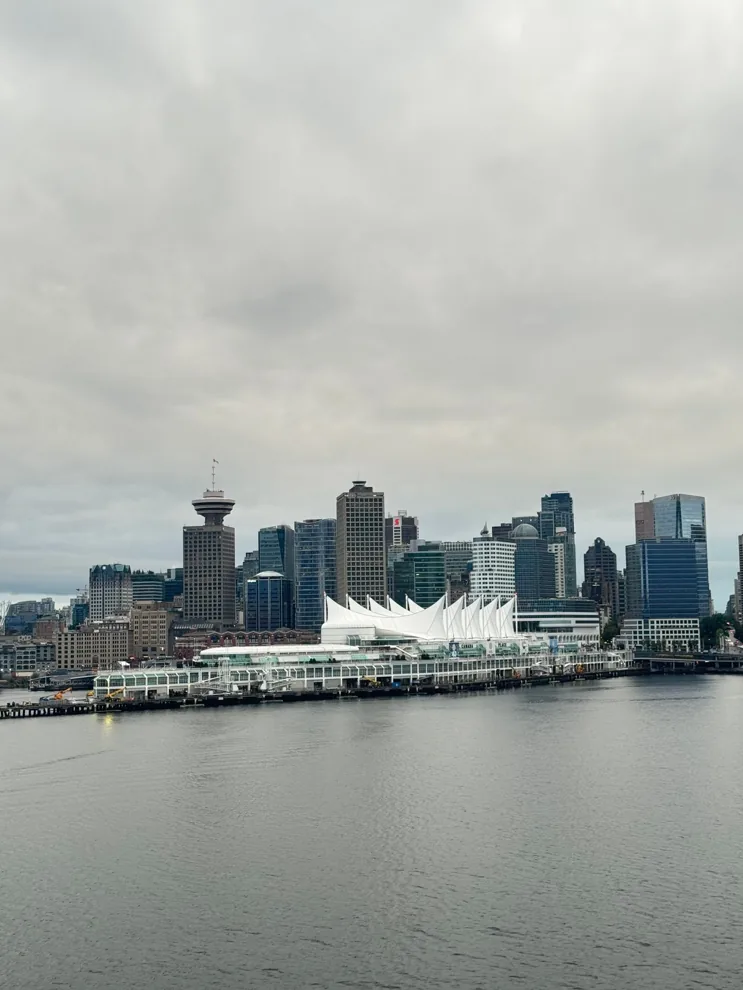
Vancouver downtown skyline across the harbour, for visitors deciding where to stay in Vancouver by Masaru Suzuki, Unsplash.
Water and distant mountains at English Bay by Vlad D, Unsplash.
Marina and downtown towers at the Stanley Park waterfront by Holly Booker, Unsplash.
Water taxi on False Creek with Burrard Bridge behind it by Chad Montgomery, Unsplash.
Cruise ship moored next to Canada Place’s sail-shaped roof by Uzay Yildirim, Pexels.
Vancouver high-rises and a bridge overlooking boats on False Creek by Ahmad Bader, Unsplash.
Gastown Steam Clock lit at night in Vancouver by Alex De Ataide, Pexels.
Vancouver towers and harbour lights at dusk by Prince Deol, Unsplash.
Stanley Park cycling timelapse by Vancouver Park Board.

2 Comments